Wake it. Make it.
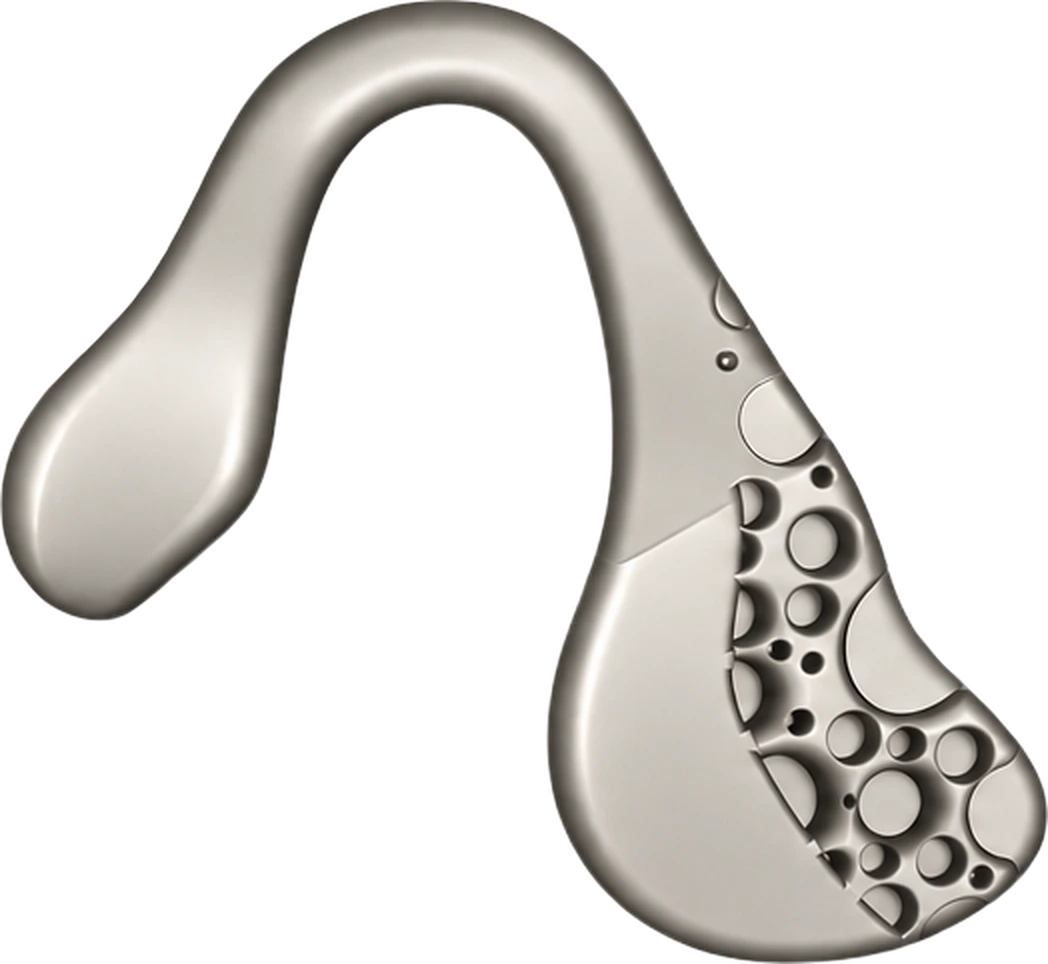
A device that means you never miss your stop.
— Project Info
| Role | Product Designer |
| Duration | 1 Month |
| Tools | Fusion 360, Figma, FigJam, Procreate, Photoshop |
| Skills | Prototyping · CAD · Electronics · Competitive Analysis · User Interviews · Product Research · Sketching · Product Development · User & Market Research |
Challenge
Millions of commuters fall asleep on trains every day and miss their stop. Phones in pockets don't detect drowsiness, loud alarms disturb other passengers, and nothing passively monitors sleep onset in a transit context.
Solution
Seventh Sense is a wearable ear device that detects early signs of drowsiness through head movement. A gentle vibration and bone conduction alert wakes only the wearer — quietly, before they miss their stop.
Colourways
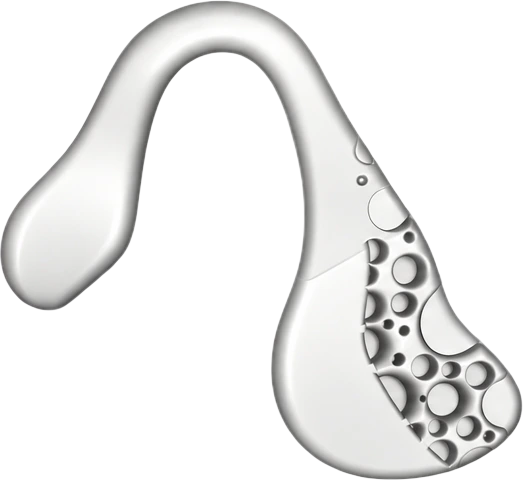
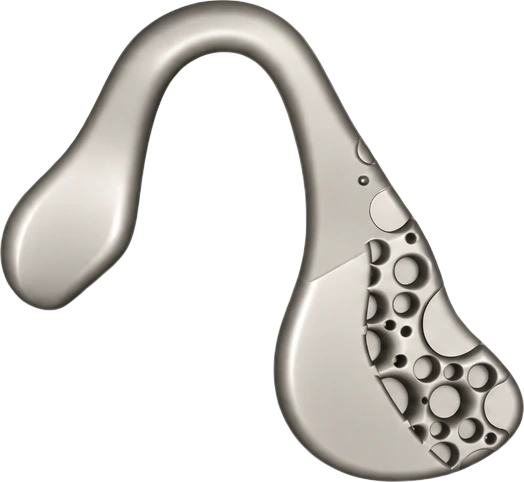
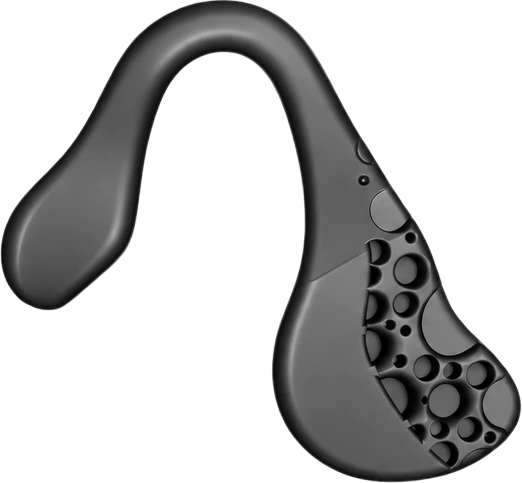
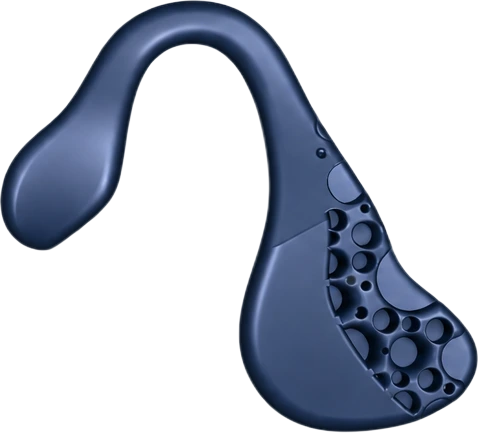
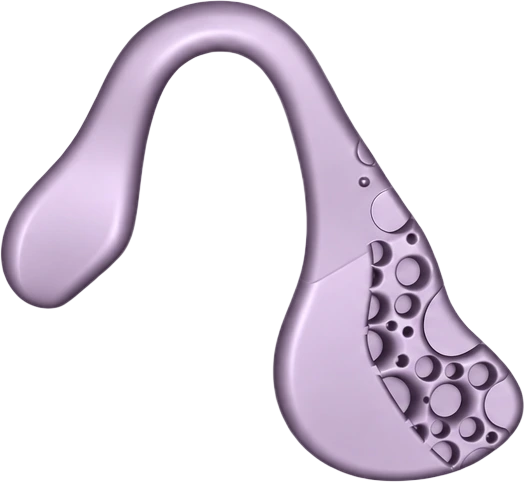
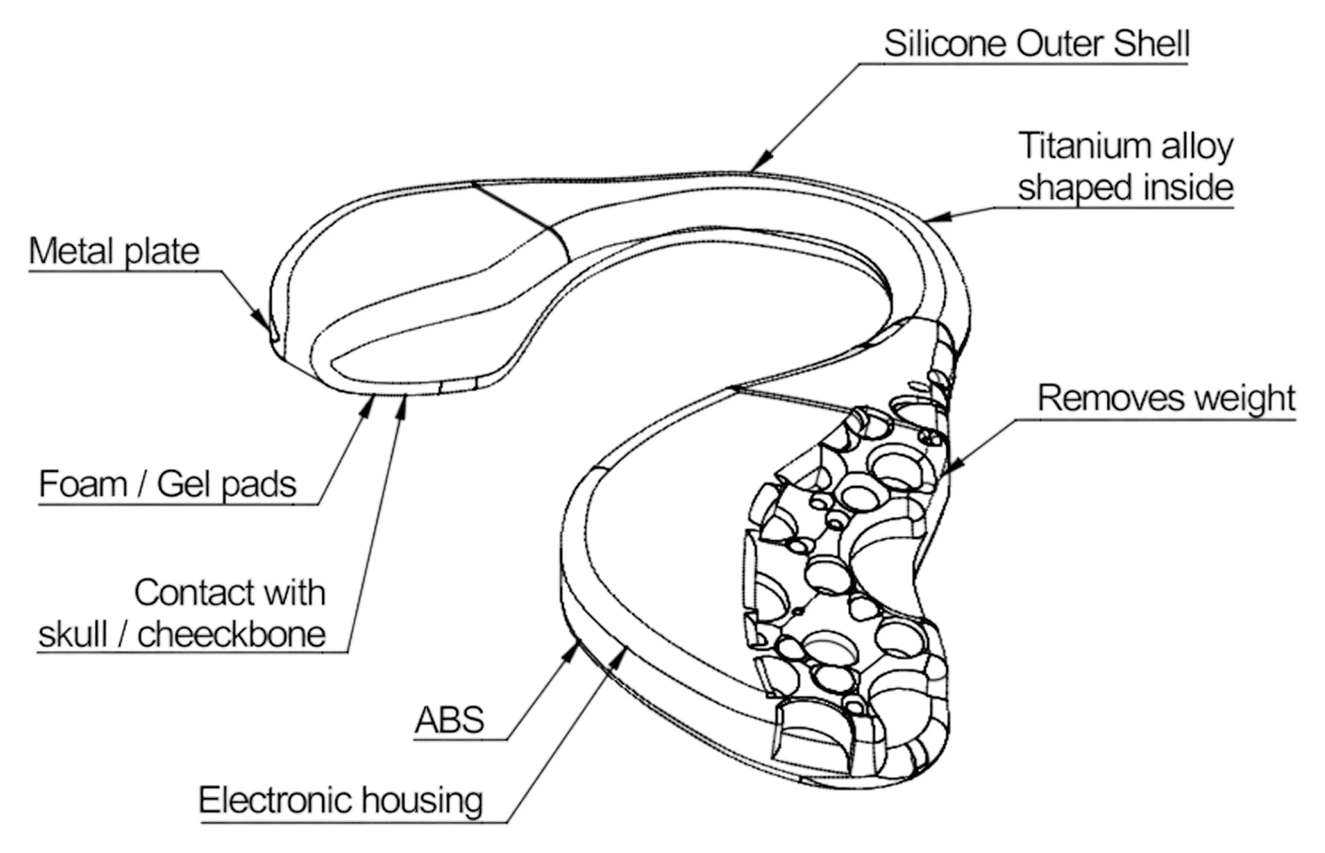
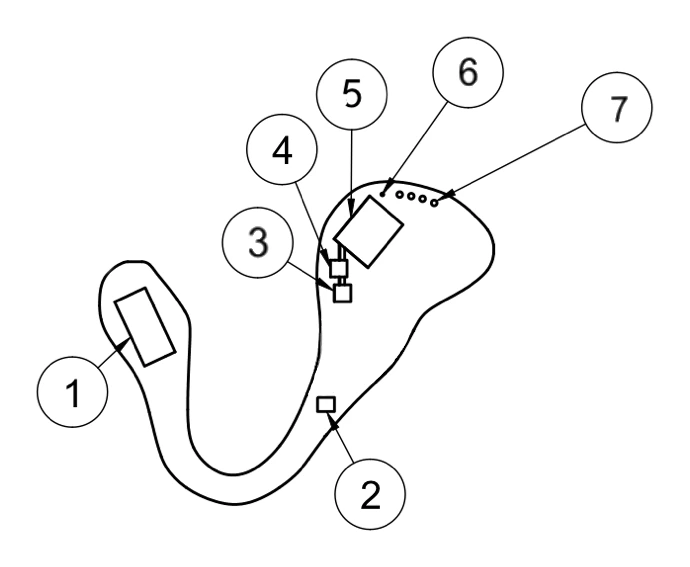
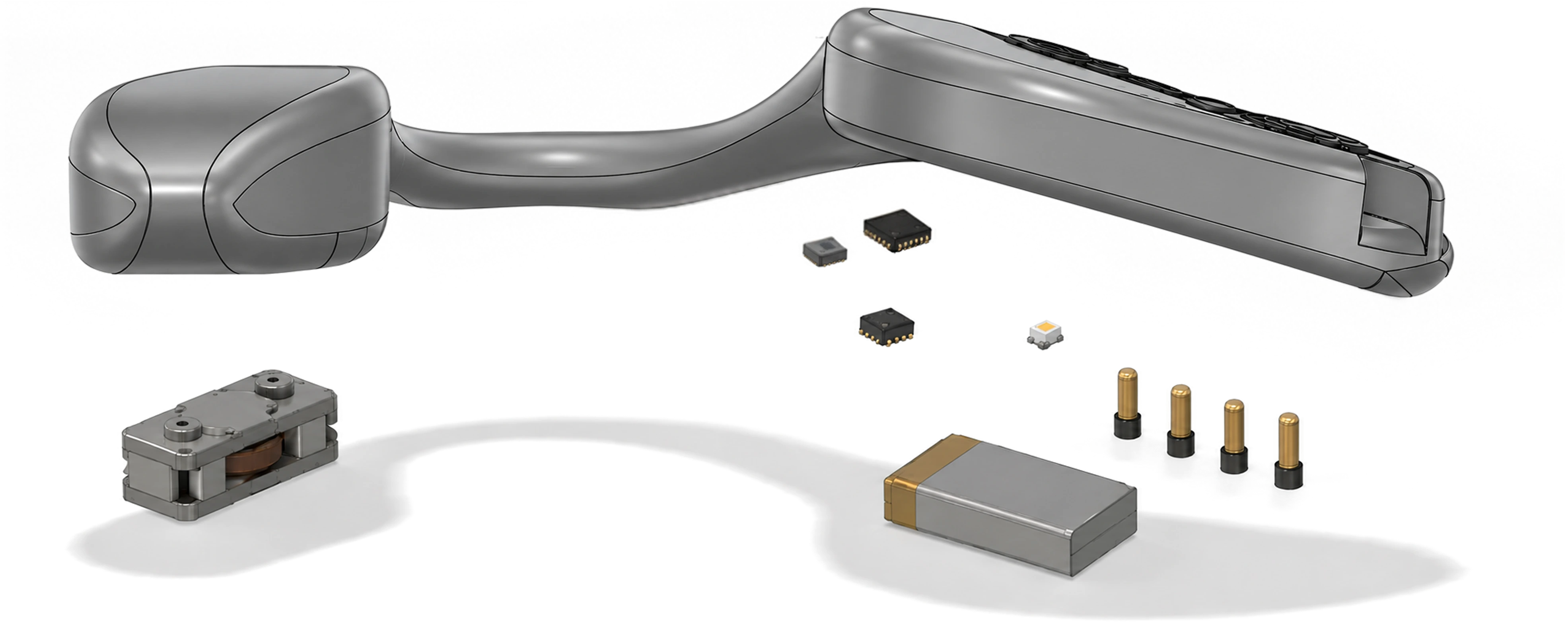
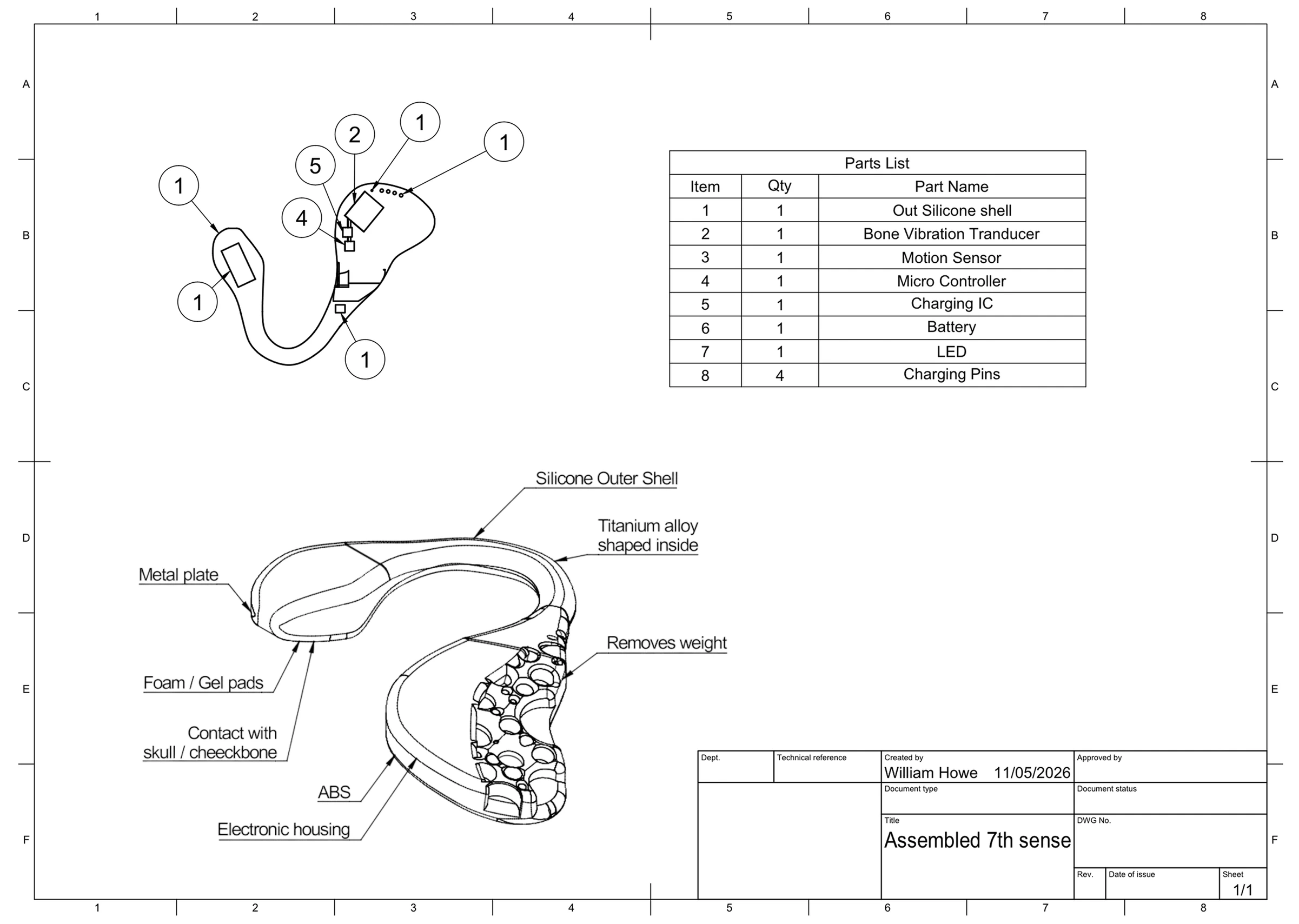
Excito — materials and components
Moodboard
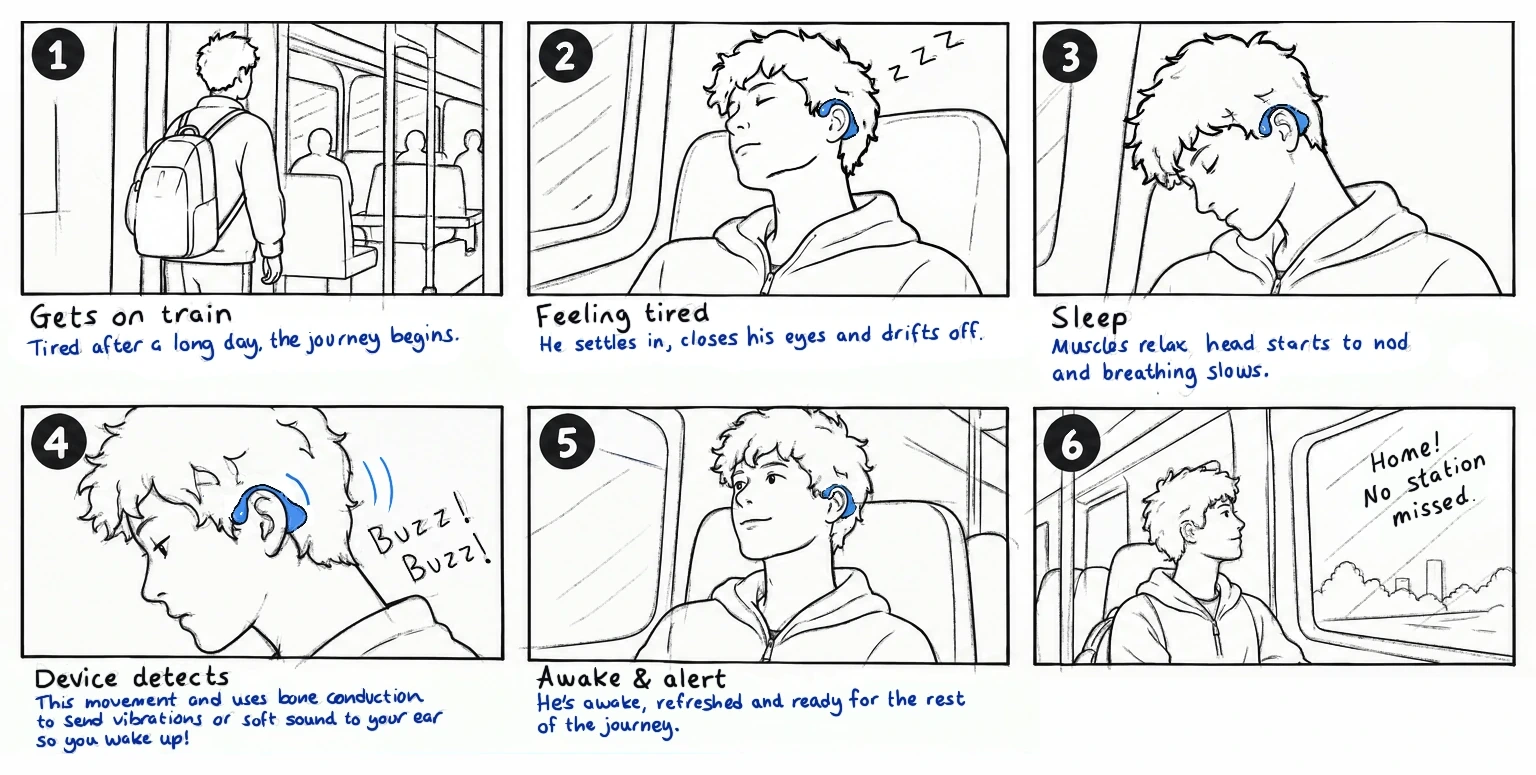
Missing your stop is more common than you think
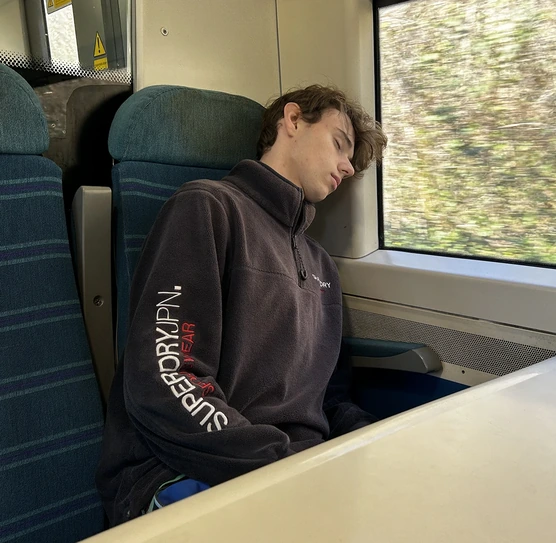
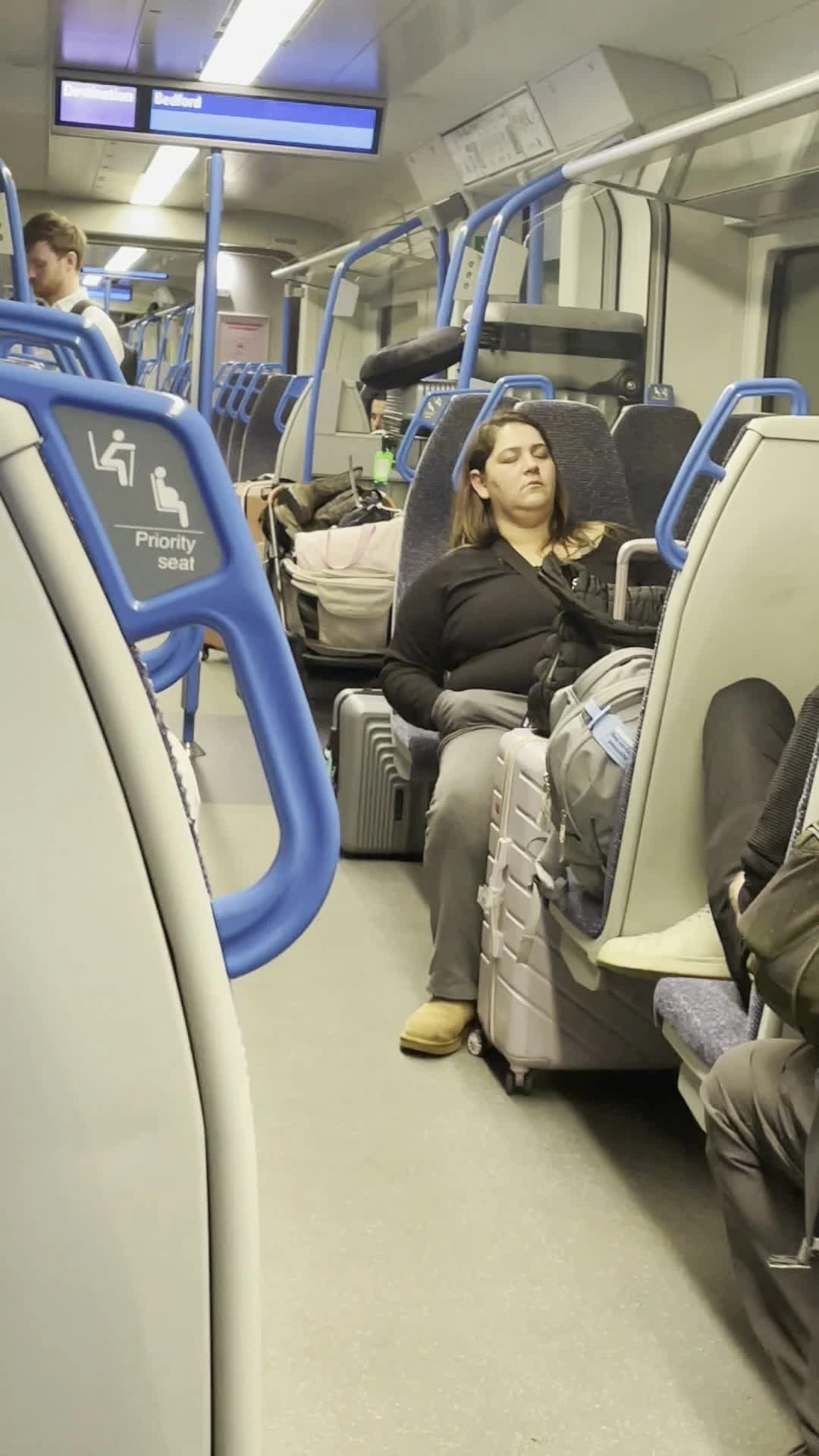
Falling asleep on public transport is something most people brush off — until they miss their stop. I'd seen it happen to friends after late nights studying or a night out, and eventually it happened to me too. The problem isn't that people are tired. It's that nothing alerts them before it's too late.
- 2/3 of train passengers have fallen asleep on their commute, with over a quarter waking up past their stop — Trainline survey
- 4 in 5 university students I spoke to had missed their stop after a late night out or studying — from an informal sample of 15 peers at Central Saint Martins
It made me wonder — was there a way to catch yourself before missing your stop?
Why do people fall asleep on trains?
I focused my research across three areas: why people fall asleep on trains, where it happens most, and what physically occurs in the body as someone drifts off. That third thread was the most critical for product development. Understanding the earliest signs of sleep onset told me what signals a wearable device would need to detect and what output it could use to intervene before the user missed their stop.
Why — people fall asleep on trains
Rhythmic Motion & Sound
The train's swaying and low frequency track noise activate the parasympathetic nervous system, inducing sleepiness.
Environmental Factors
Warm carriages, repetitive scenery, and boredom all promote drowsiness.
Comfort & Security
Trains are low stress, enclosed environments that allow the brain to switch off.
Pre-existing Fatigue
People commuting after a long day or when sleep deprived are far more likely to fall asleep.
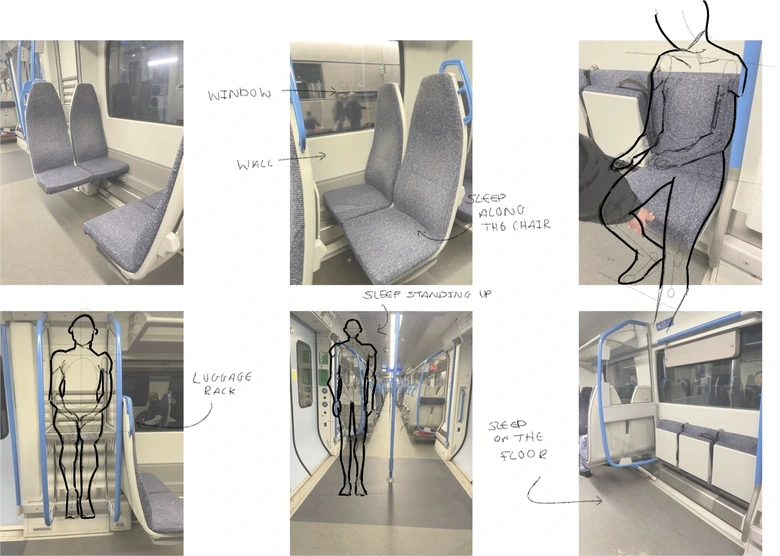
Where — people are most likely to fall asleep
I mapped out the journey a typical train passenger takes, from:
- boarding
- finding a seat
- putting in headphones
- scrolling their phone
- gradually zoning out
to identify the moments and locations where falling asleep is most likely to occur.
What — happens to the body as sleep sets in
Sleep Stages · Secondary research
Awake
Alert
N1
Drifting
N2
Deeper
N3
Deepest
REM
Dreaming

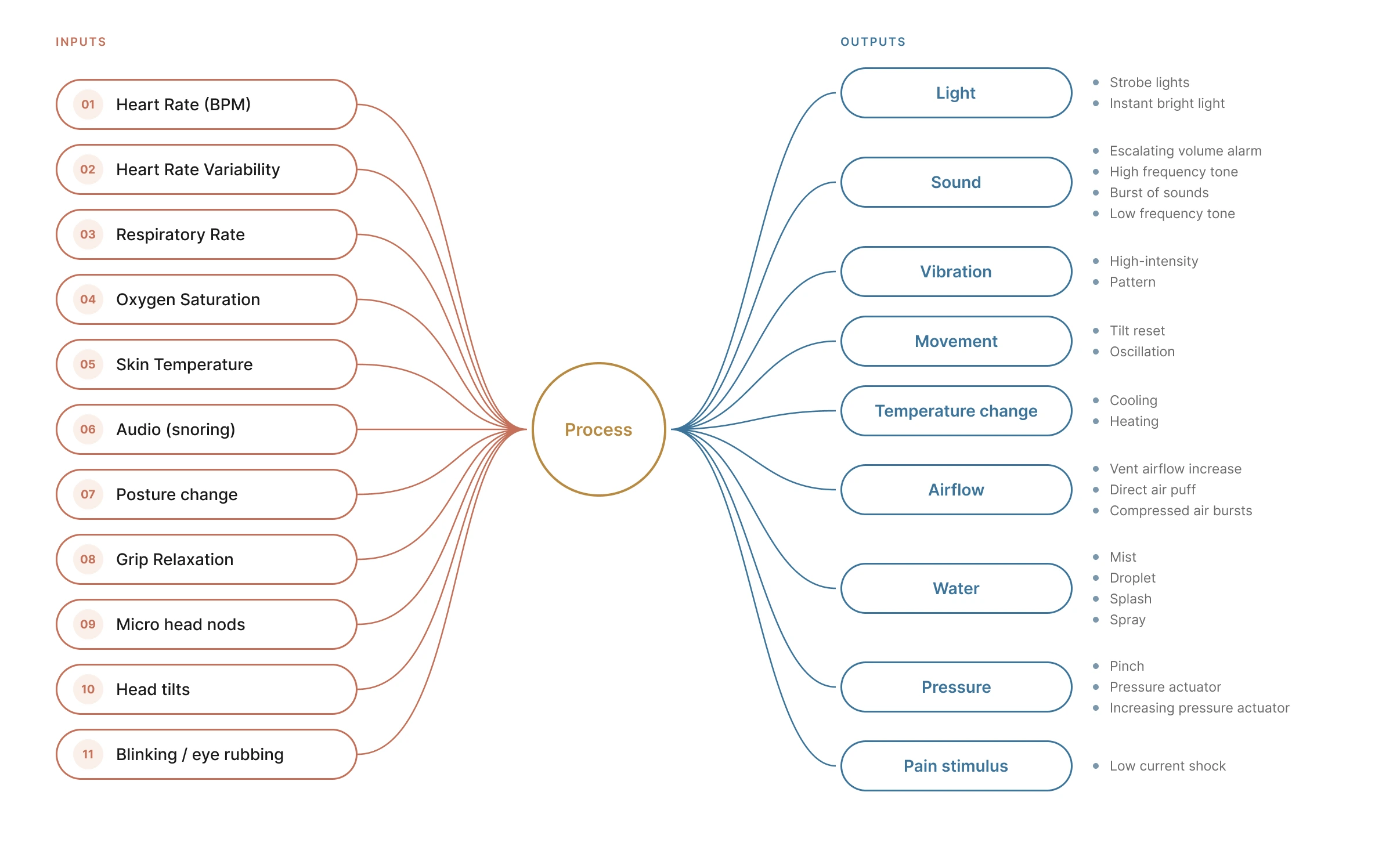
Inputs → Outputs — what the device senses, and how it responds
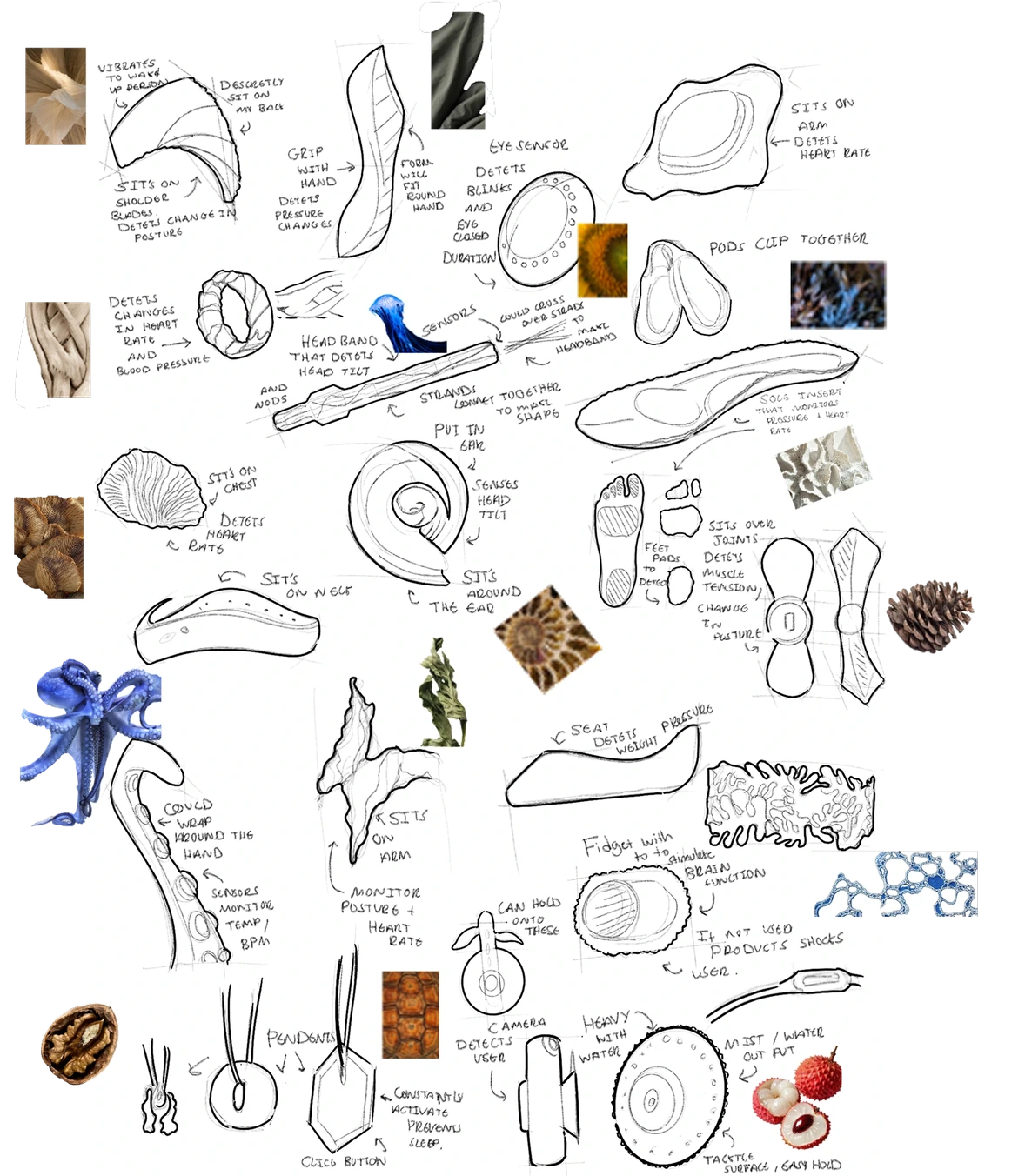
Initial sketches
I sketched over mood board imagery to explore organic forms, textures, and colour, using these explorations to inform early design concepts.

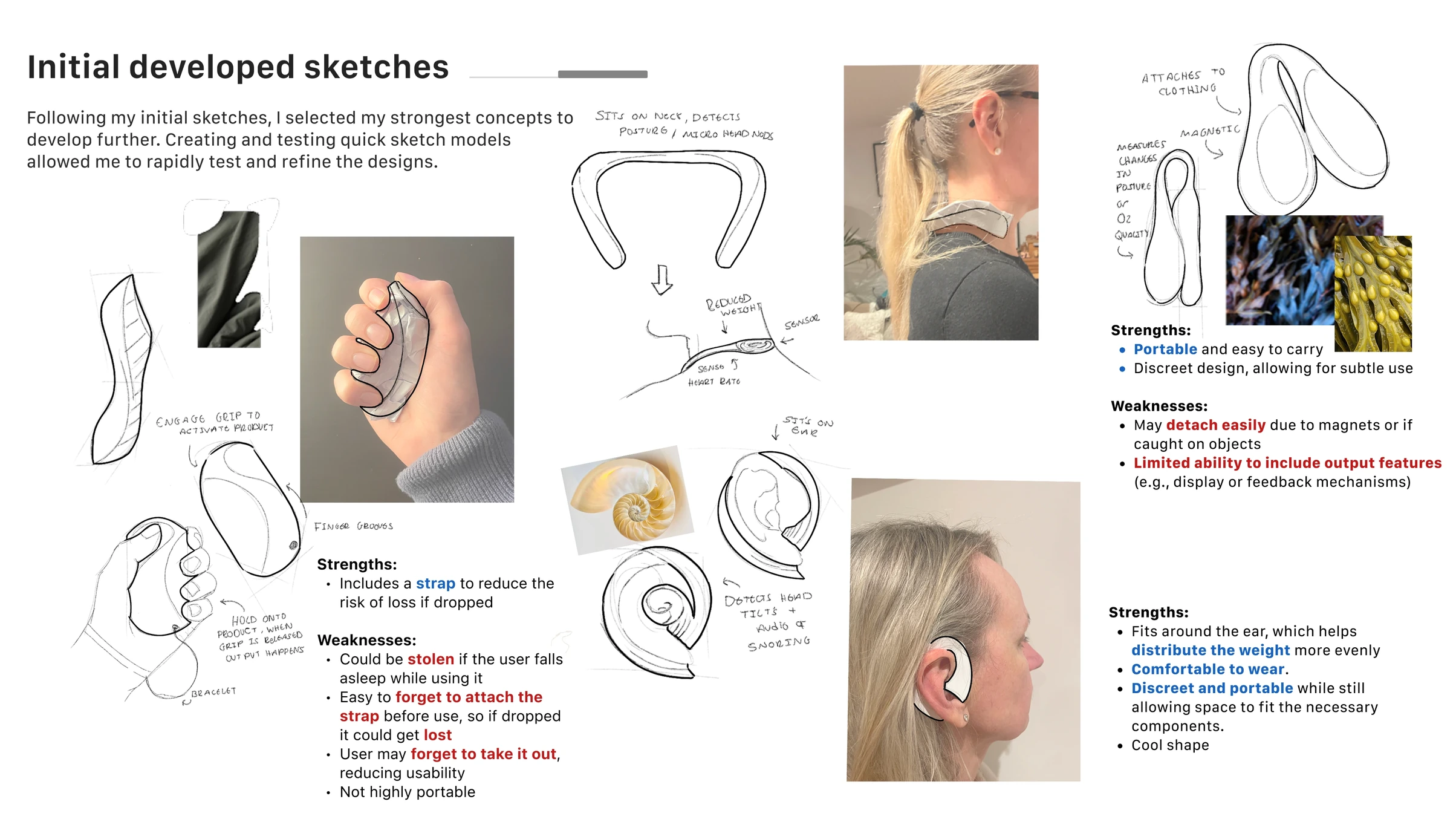
Concept development & user testing
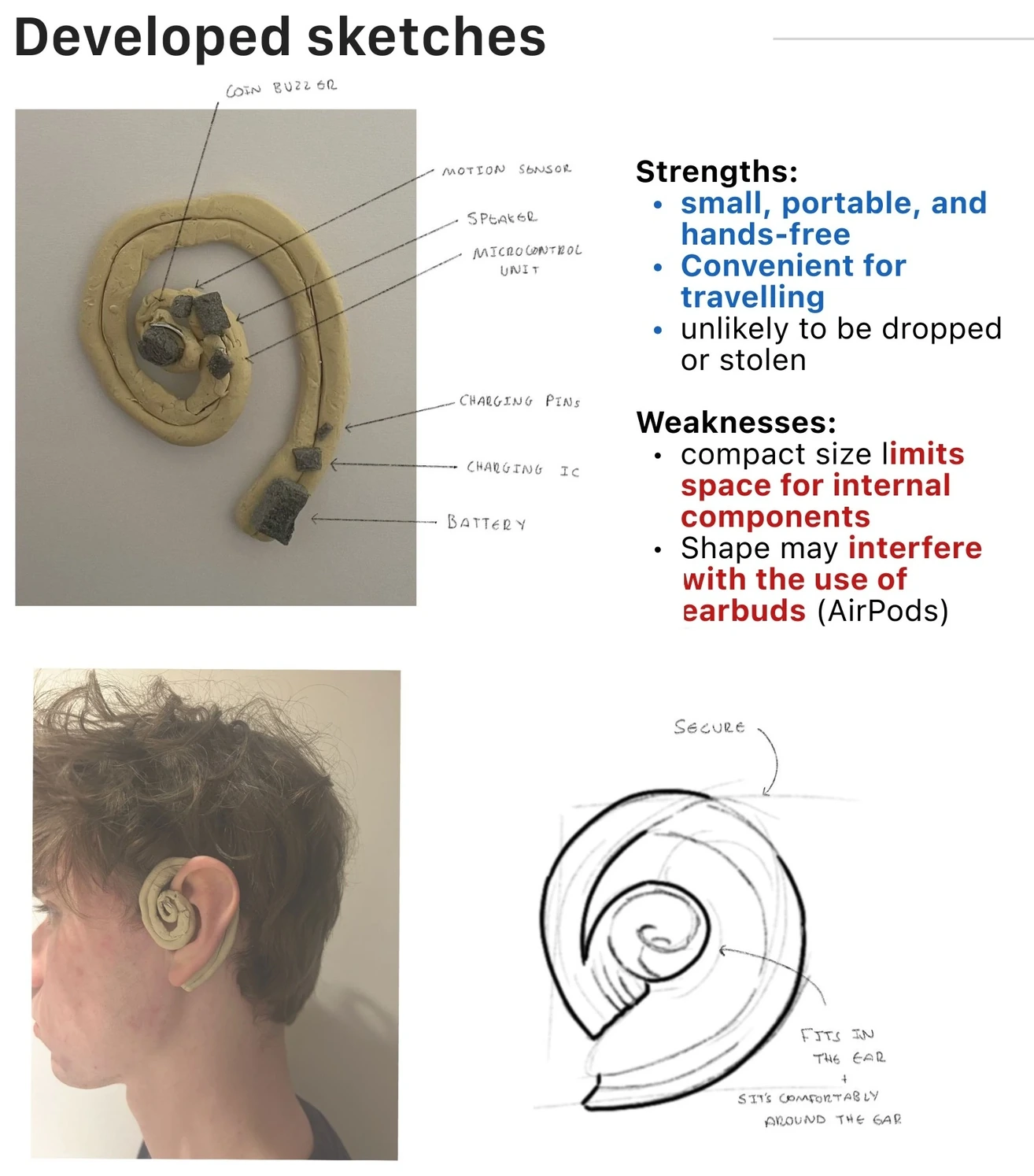
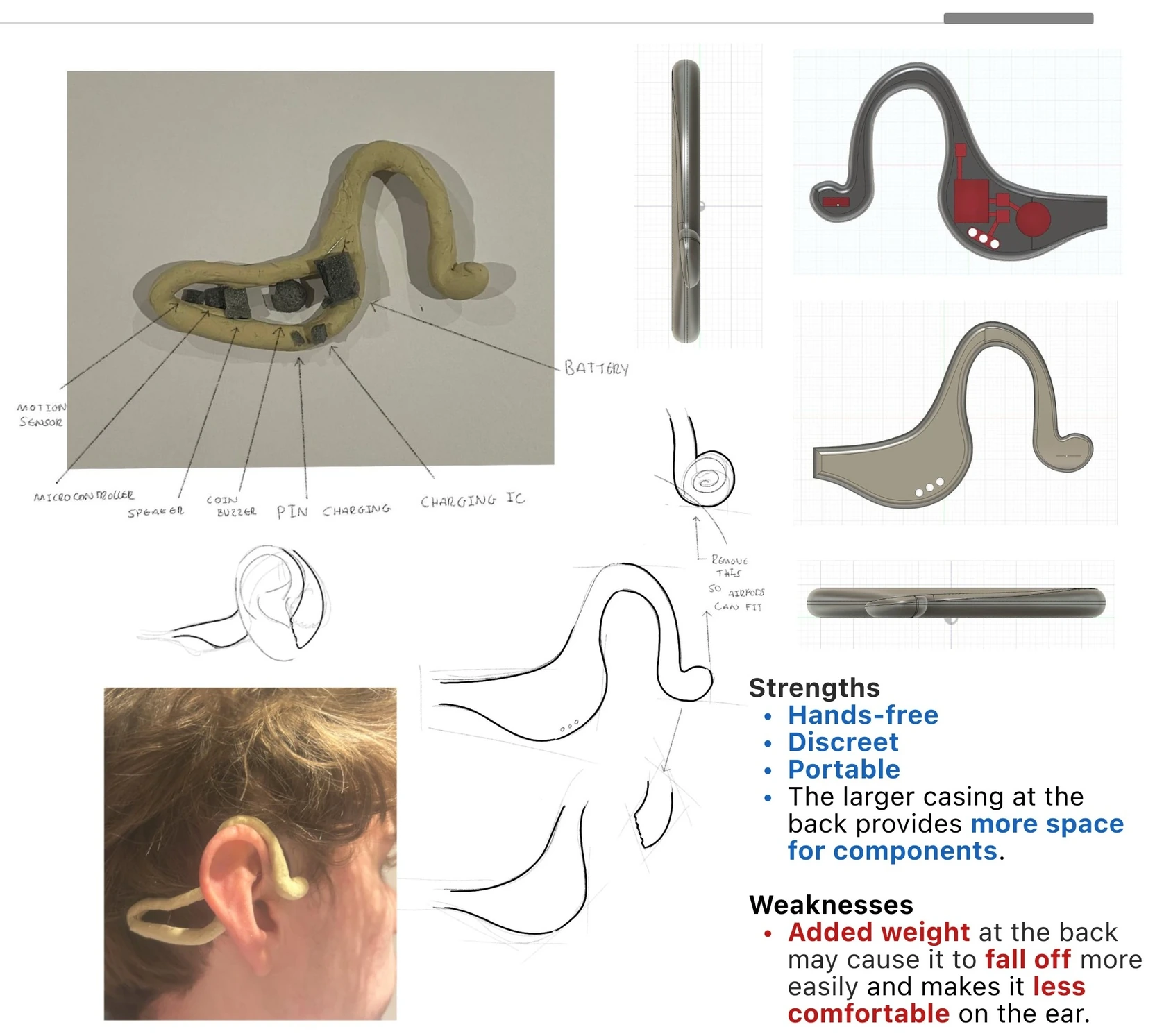
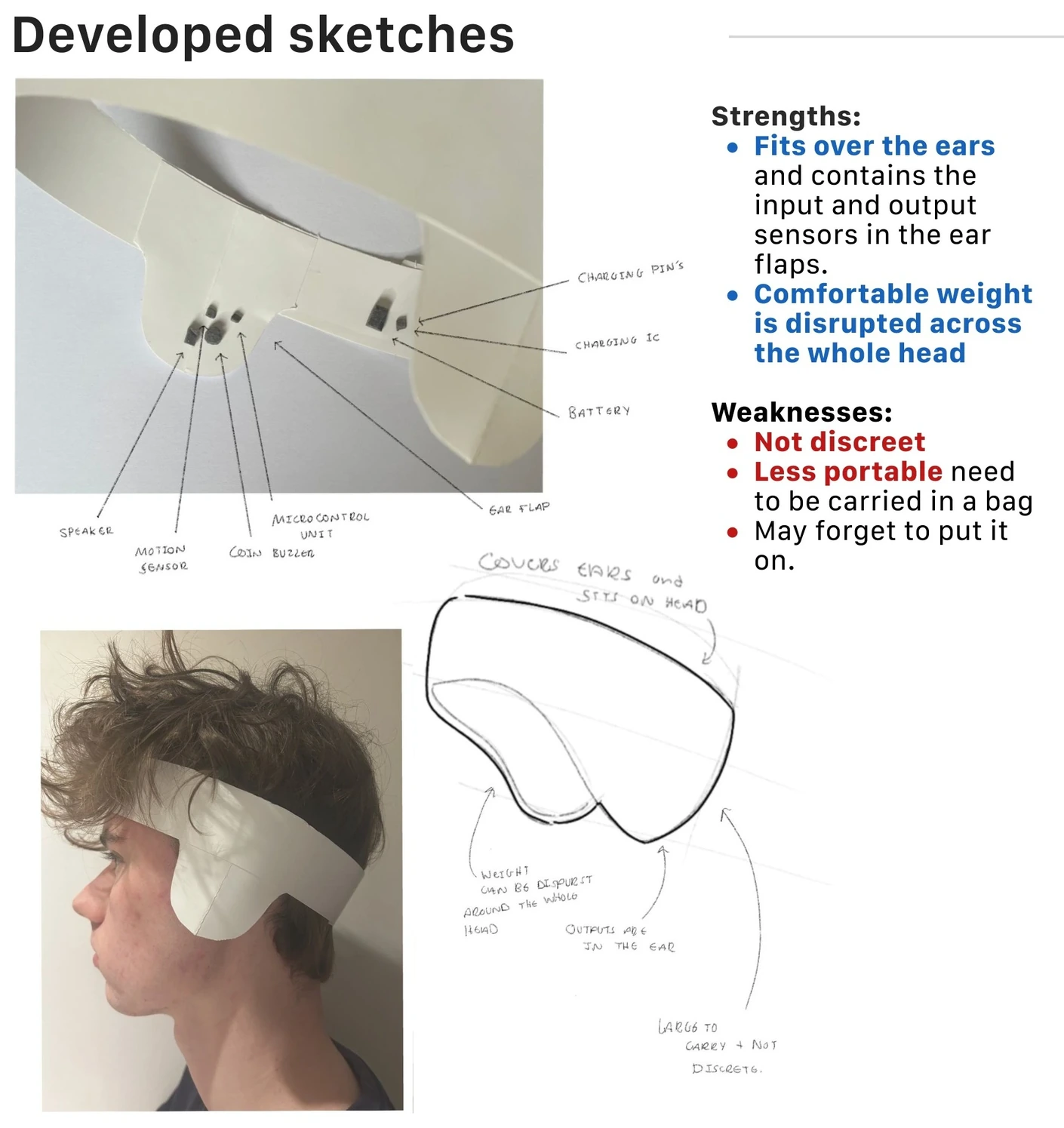
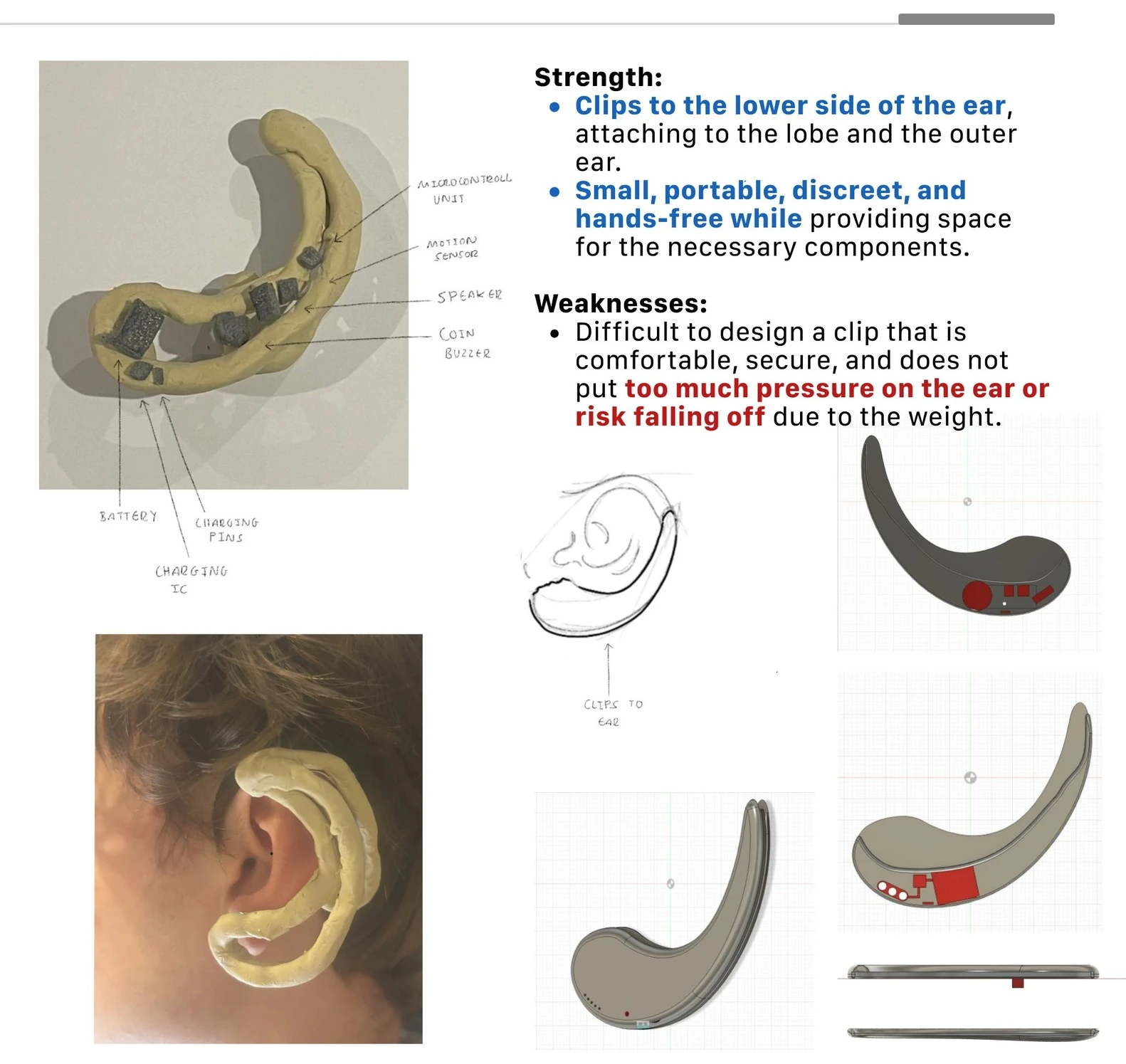
I developed a wide range of concept directions across different body placements — handheld, neck-worn, and ear-worn — evaluating each against the core criteria of discretion, portability, and space for electronics.
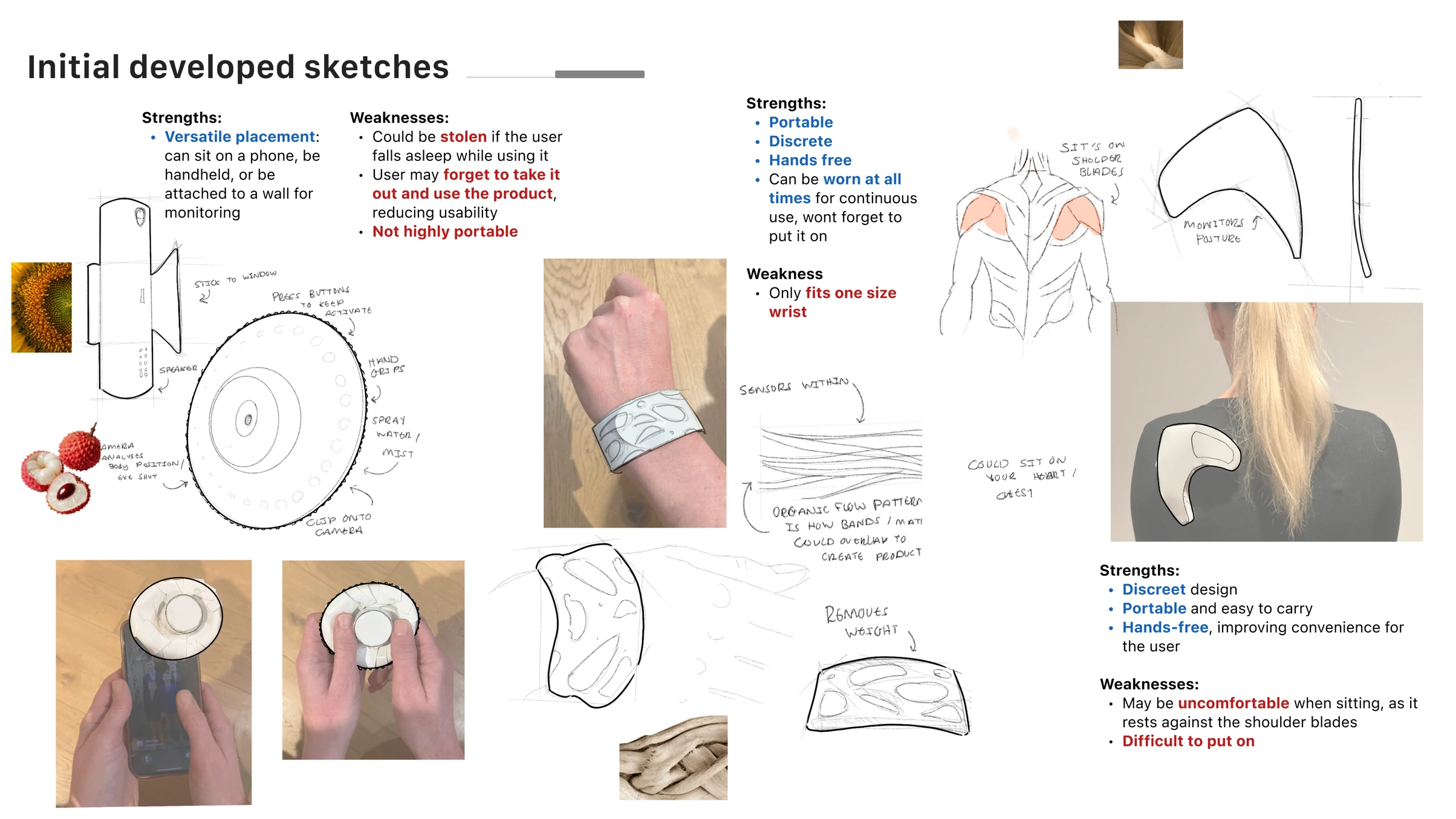
Why not handheld or worn?
The handheld concept introduced theft risk and required active effort to use — both deal-breakers for a passive wearable. The wrist direction was portable and hands-free, but limited to a single size. The shoulder-blade placement was discreet but uncomfortable when seated and difficult to put on independently.
Why the ear?
The ear offered the best balance — discreet, hands-free, continuously wearable, and compatible with existing products like AirPods. It sits close to where motion sensors can best detect the subtle nodding and tilting that signal drowsiness.
Understanding the components
Before developing further, I researched potential components that could be used within the product — exploring real-world parts to understand their physical dimensions, weight, and how they might integrate into the design. This included looking at how each component functions, what role it plays in the system, and whether it was feasible to fit within a compact, wearable form factor.
| Type | Component | Dimensions | Function |
|---|---|---|---|
| Input |  Motion SensorBosch BMI270 |
2.5 × 3 × 0.8 mm | Combines an accelerometer and gyroscope to track subtle 3D head tilts, drops and nods that signal nearing sleep. |
| Process |  MicrocontrollerNordic nRF52832 |
3 × 3 × 0.9 mm | Processes motion sensor data by interpreting head nods and tilts, then triggers corresponding outputs such as vibration or sound alerts. |
| Output |  Vibration MotorCoin type |
8 mm dia. × 3 mm | Converts electrical signals from the microcontroller into mechanical vibrations to notify the user. |
 Micro SpeakerEarbud type |
6 mm dia. × 2–3 mm | Produces audible alerts by converting electrical signals into sound, alerting the user. | |
| Power |  Micro PCBFlexible circuit board |
Varies by layout | Holds and connects the components together, distributing power from the battery to all parts of the system so they can function properly. |
 Micro Li-Po BatteryRechargeable cell |
10 × 8 × 3 mm | Provides power to the device using a small, rechargeable cell. Compact, lightweight and replaceable. | |
 Charging ICMCP73831 |
3 × 3 × 1 mm | Manages safe Li-Po battery charging by regulating current flow, preventing overcharging and damage. | |
 Charging ContactsPogo pins |
1–2 mm diameter | Transfers power from a charging case to the battery via spring-loaded contacts, enabling compact, reliable charging. |
Using these components I will iterate my designs whilst considering the positioning, weight and noise of these components.
Iterating — models & user testing
With the ear-worn concept identified as the strongest direction, I explored a range of design variations — refining form, fit, and component placement through sketching, physical modelling, and CAD. Each iteration was tested with real users, gathering hands-on feedback on comfort, discretion, and wearability, which directly informed the next round of development.
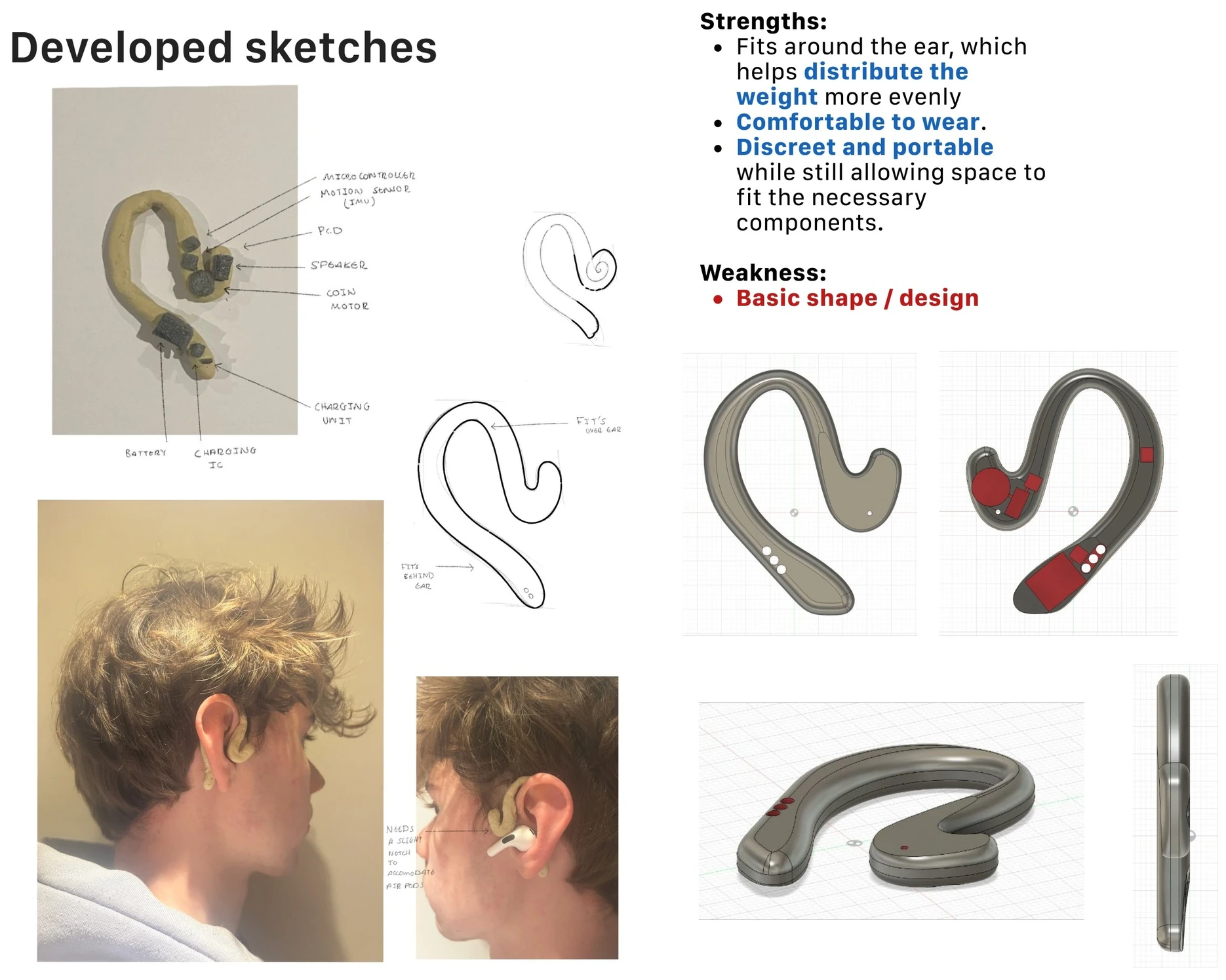
Chosen Design
User Feedback
Strengths
- •Discreet and unobtrusive design
- •Compatible with existing products such as AirPods
- •Can be worn continuously throughout the day
Weaknesses
- •Sound / vibration could disturb others nearby
- •Considered too sterile / lacking character
- •May become uncomfortable or sweaty with prolonged contact
Detect. Score. Alert.
I researched how the system would actually work — how to detect that someone is genuinely falling asleep, not just reacting to a bumpy ride or turning their head. I then looked at how to translate that into an output that could wake the user without disturbing anyone around them.
Input — Detect
From observational studies and research on drowsiness, the nod cycle produces the pitch oscillation pattern plotted above:
- Head slowly tilts forward
- Neck loses stability
- Head drops quickly
- Person reflexively corrects posture
- Cycle repeats, deeper each time
Repeated nodding behaviour has been observed as a reliable marker of drowsiness state.
Process — Score
I wrote an algorithm that reads drowsiness from the nod sequence: angle, speed, and how many in a row.
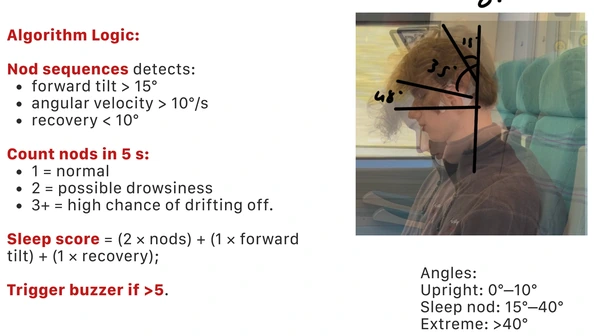
Differentiating head nods from train bumps
Human nods are low-frequency (0.1–2 Hz) and large-angle, while train vibrations are high-frequency (5–30 Hz), small-amplitude noise. A 3 Hz low-pass filter cuts the vibration, not the nods.
Output — further component & material research
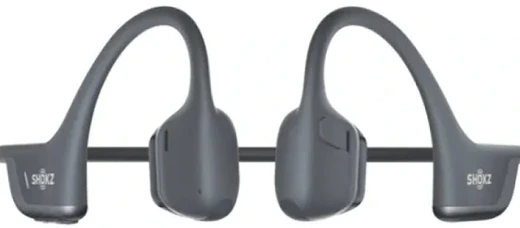
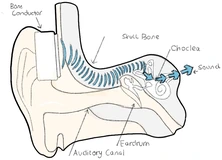
A buzzer would disturb the whole carriage, so I needed an alert only the wearer would notice, which led me to explore bone conduction.
Existing products
Shokz OpenRun Pro 2
How it works
Vibration travels through the skull to the cochlea, bypassing the eardrum.
Testing
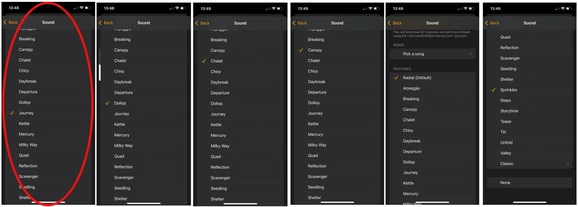
Tested over a week — Journey woke me most reliably.
| Type | Component | Model | Dimensions | Function |
|---|---|---|---|---|
| Output |  Bone Conduction Transducer |
GD02 | 12.6 × 6 × 4 mm | Converts electrical signals into vibrations that transmit sound through bone conduction. |
Further Development
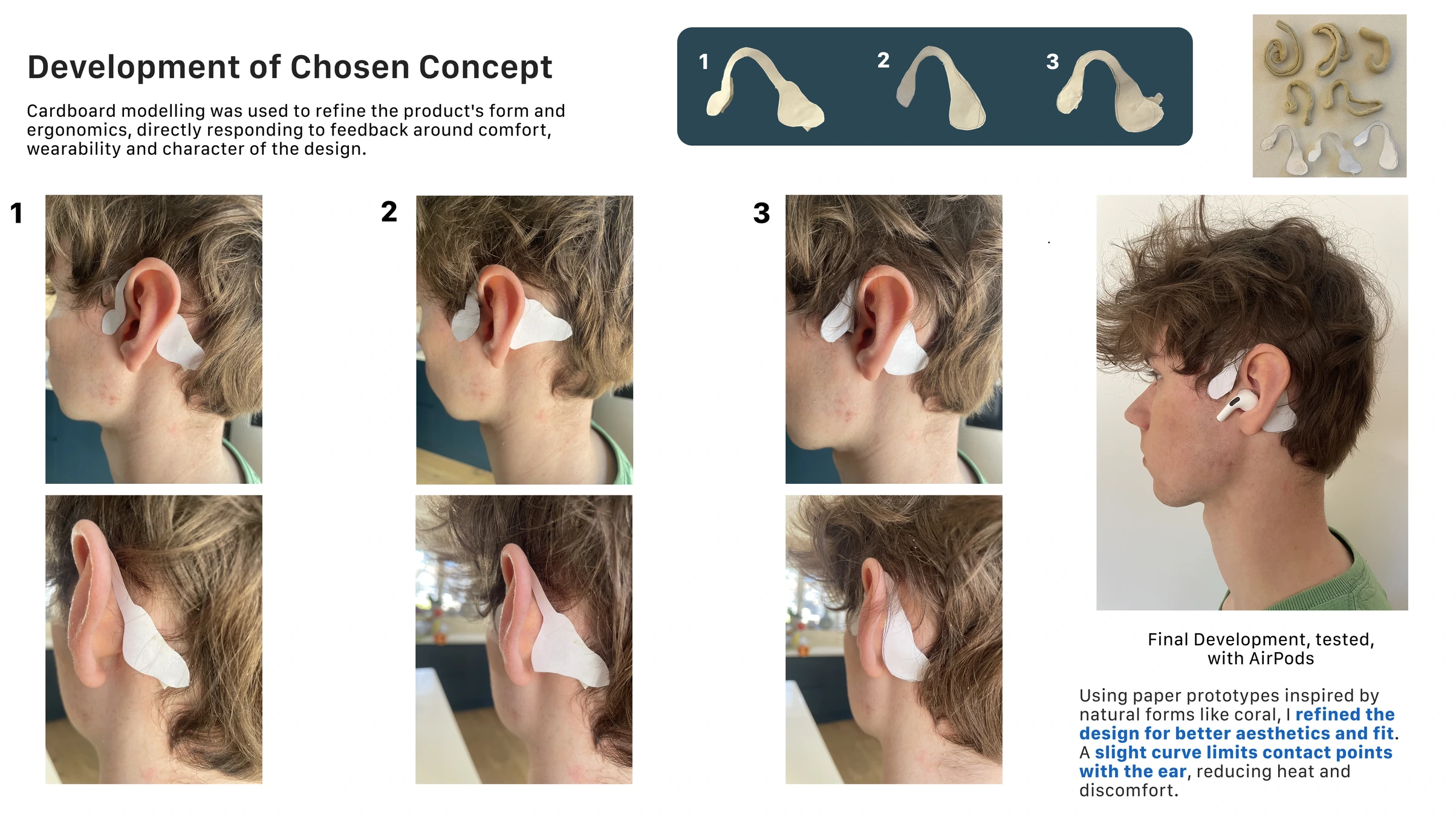
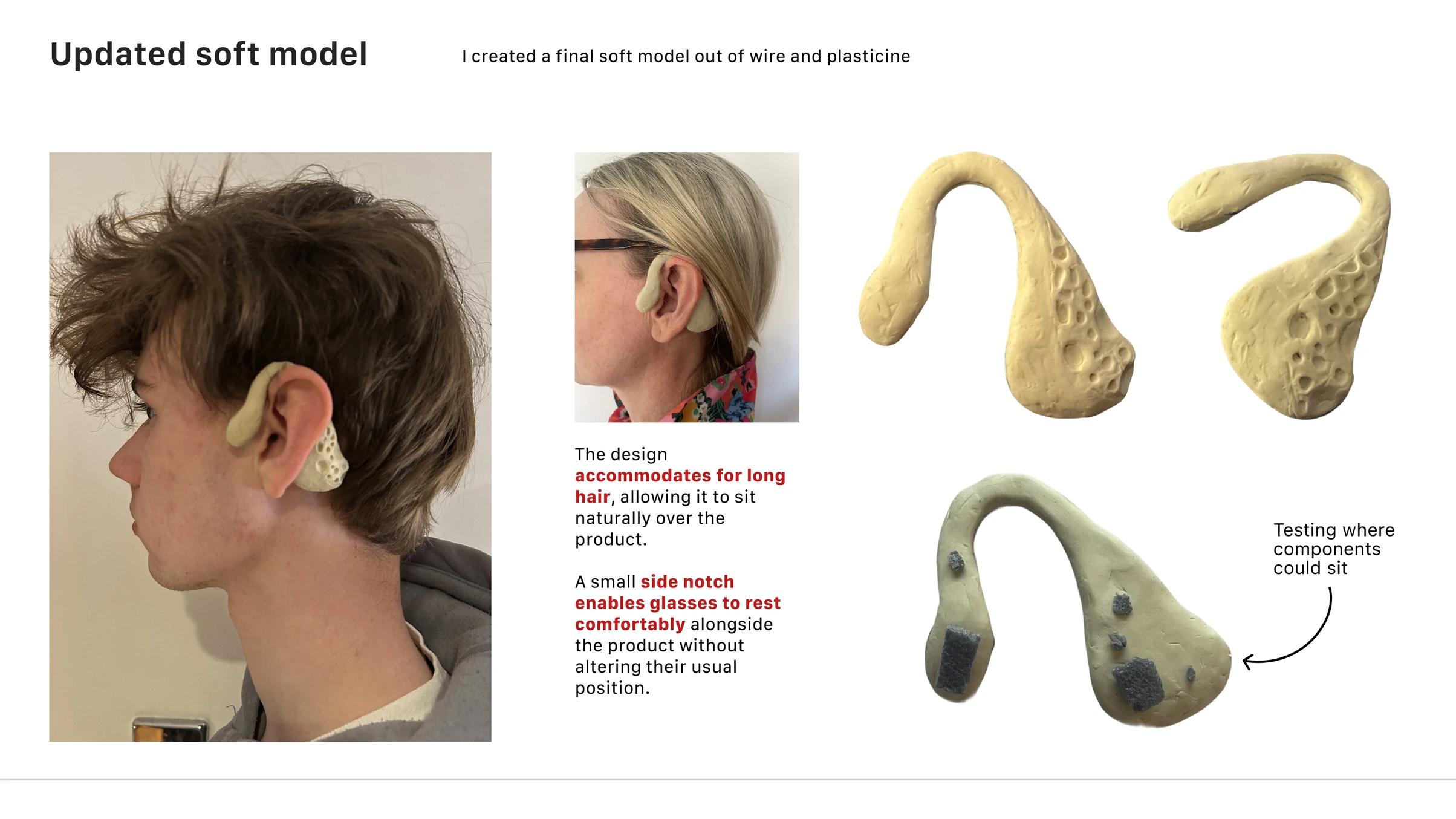
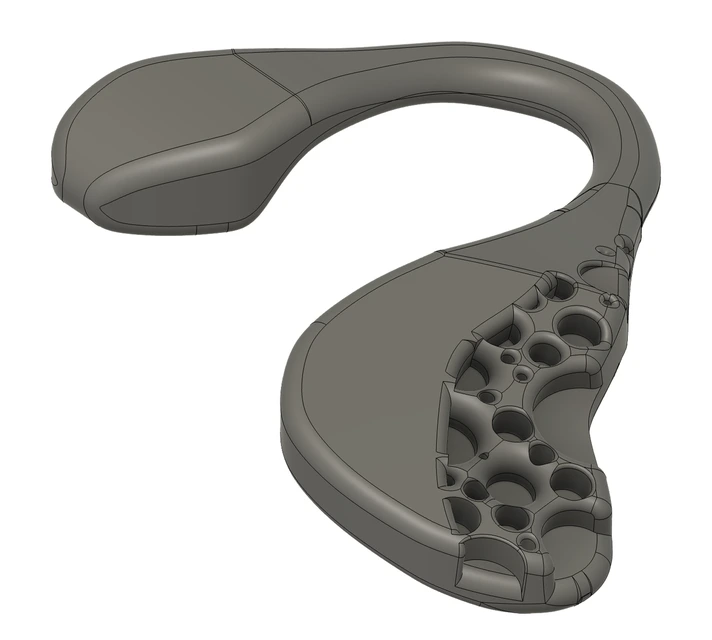
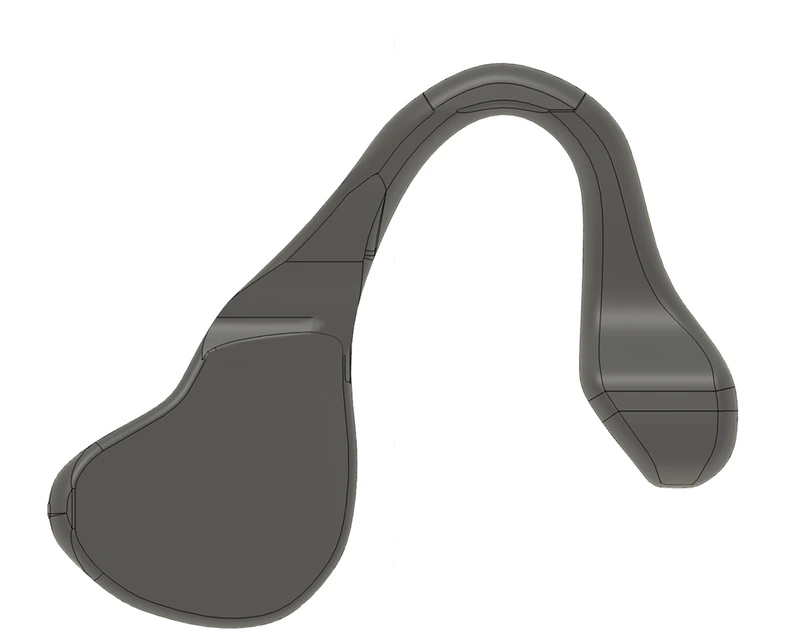
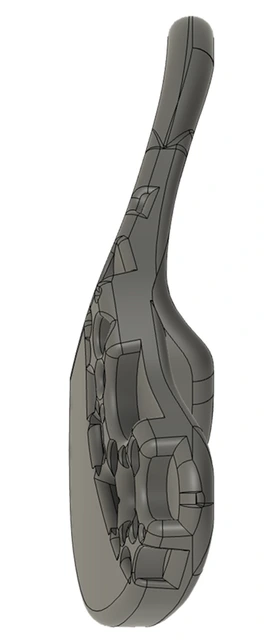
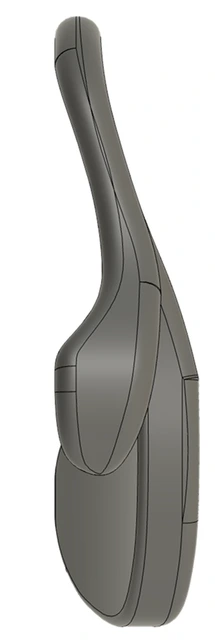
With the components settled, I went back to the form. Using the earlier user feedback I refined the shape for comfort, mapped the components onto it, and built a closer physical prototype to test how it would actually feel to wear.
What user testing changed
- —A slight curve shifts where it sits on the ear, making it far more comfortable.
- —It sits under long hair rather than fighting it, so it stays discreet.
- —A side notch lets glasses rest in their usual position.
- —Tested alongside AirPods, since it has to work with what people already wear.
- —Coral-inspired paper prototypes gave the shape the character it lacked.
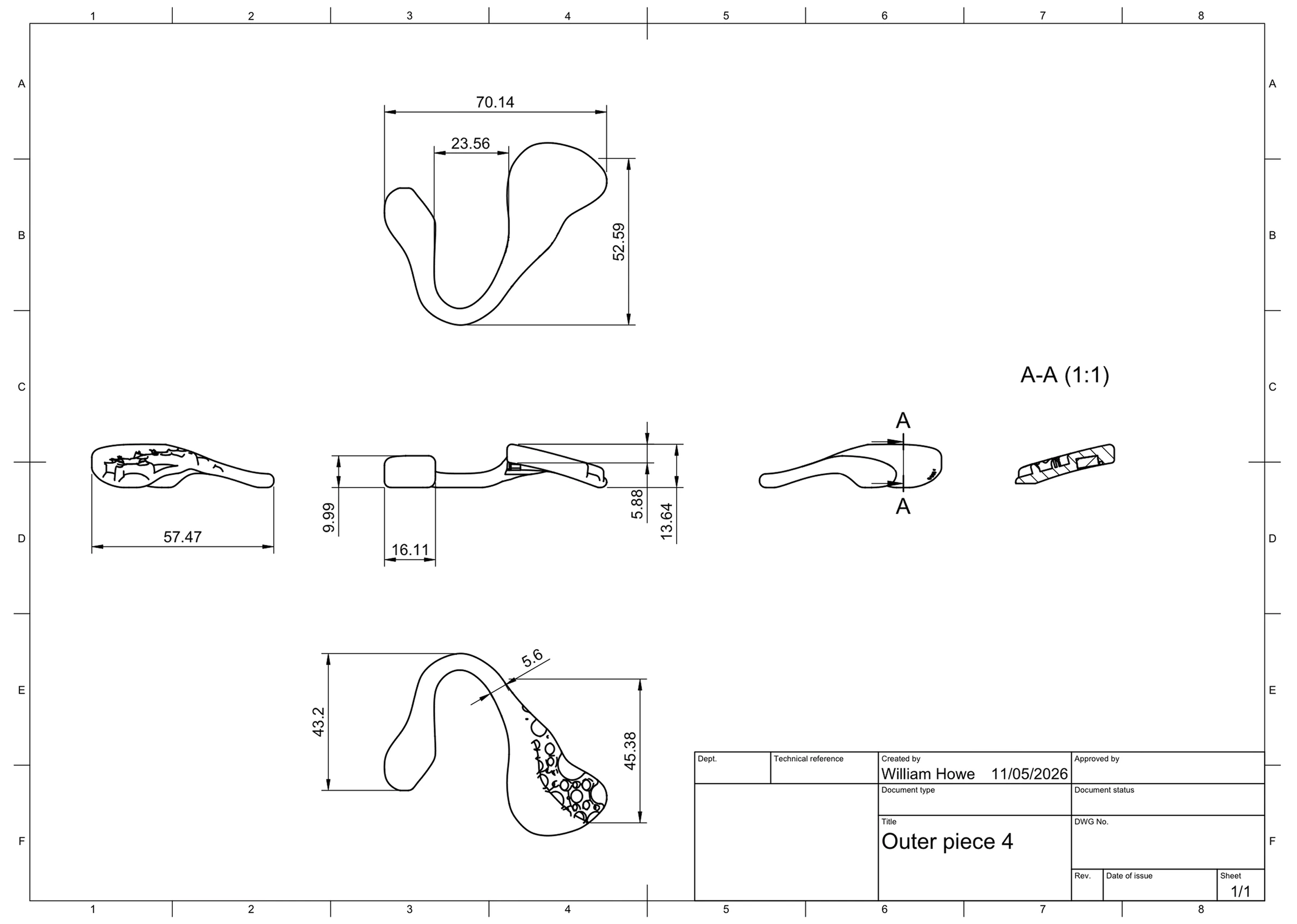
CAD
Branding
Brand colour
Product colours
Midnight blue
Taken from the late-night journeys Excito is made for. Four tones step from dusk to deep night — the hours when people drift off on the way home.
Minimal product colours
Five quiet, everyday finishes, so the earpiece reads as something you wear rather than a gadget, and stays discreet on a commute.
The wordmark
A custom geometric typeface. The E, X and T are each cut along the same vertical line — a clean break that mirrors Excito interrupting sleep. Modern, precise and calm.
Reflection
- Fit around what people already wear. Hearing aids, glasses arms, piercings and over-ear headphones can all obstruct the fit. Designing around them widens who the product works for.
- Refine the detection algorithm. The thresholds came from nodding I observed, but on a small sample. Next: test more wearers and the awkward cases — bumpy track, turning to talk, looking down at a phone — and tune until false triggers are rare.
- Make the wearer confirm they are awake. The alert stops on its own, so a half-woken person can drift straight back off. Dismissing it should take a tap, or a head shake the motion sensor already reads, with the alert escalating if nothing comes back.
- Evidence over assumption. Thresholds grounded in observed nodding; alarm tones tested on myself across a week. Every value I set was one I could justify.