 VENTRA
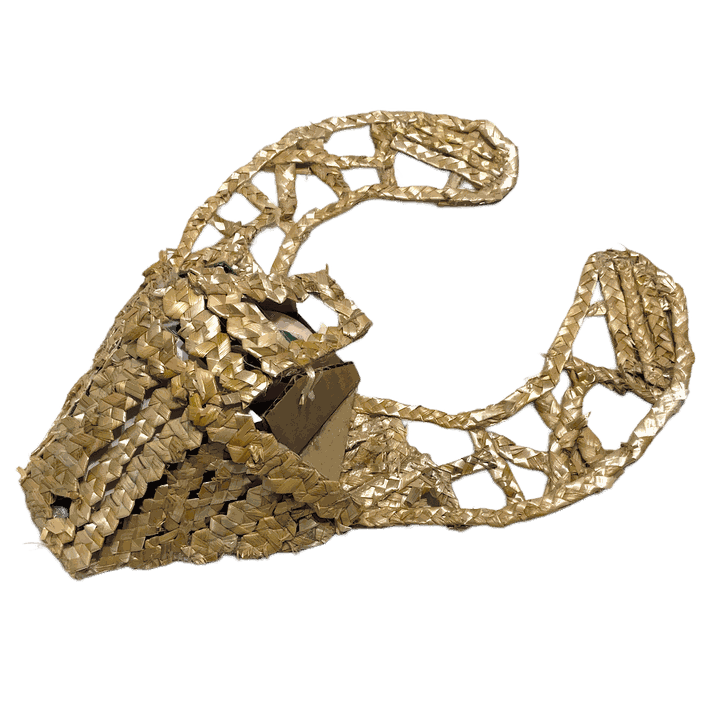
Ventra Back Flow
Unit 003GTIN 50870930245168035 · England · Made 2026
Carbon footprint
Outer shell
Traced journey
Explore this product
Product details
Stay cool, hands-free. The Ventra Back Flow is a wearable fan that sits comfortably on your back, directing airflow down your shirt so you stay refreshed without holding anything. Lightweight and portable, it moves with you.
The shell and strap are plaited by hand from dried wheat straw. Electronics are salvaged, so the exact make of switch, motor, MCU and battery varies from unit to unit — this unit’s parts are listed under Identifiers.
The tags on our product are crafted from paper that’s 100% certified and sourced from forests that are managed responsibly. Products are shipped in cardboard packaging with mycelium insulation.
- Keep in dry conditions
- Dry if the product gets wet
- Keep airways clean — remove dust
- Avoid crushing, folding, or placing heavy objects on the unit
Every unit passes eight checks at the hub that built it before its passport is issued.
- Circuit test
- Airflow test
- Fixed mounting points for components
- Salvaged components tested in isolation
- Visual quality check
- Motor clearance
- Heat test
- Strength and durability test
Passport issued by Ventra · Data verified 12 Mar 2026
Held under ESPR Article 9. Public view — repairers and recyclers see more.
Every step of this unit was recorded as it was made. Tap a step to see the detail.
- 01
Long-stem heritage wheat, grown for the stalk rather than the grain. Cut and dried on the farm, collected by car in a single 5-mile run. No irrigation or drying energy is attributed to this unit beyond the field itself.
- 02
A rustic 4-plait worked wet, then sewn in a spiral around a body mould. Roughly four metres of plait goes into one shell. Tools: needle, thread, steam. No powered machinery.
- 03
Ends trimmed and tucked, lattice openings cleared so air moves freely across the back. Airflow and heat checks are logged against this unit’s serial before it moves on.
- 04
Motor, MCU, switch and battery recovered from discarded equipment rather than bought new. Because they are salvaged, their manufacture is counted as reuse, not new production — which is why electronics sit at 12.8% of this unit’s footprint rather than dominating it.
- 05
Every salvaged part is bench-tested on its own before it goes near the shell: continuity, load, heat and clearance. Parts that fail go back into the e-waste stream rather than into a product.
- 06
Components are held with fixed mounting points and minimal bonding, so the unit opens without tools or damage. This is the decision that makes the repair screen possible.
Roughly one bus mile
Where it comes from
Figures are modelled for this unit using the materials and distances recorded above. Electronics are salvaged, so their footprint is counted as reuse, not new manufacture.
Energy in use is the one figure we will not model. The fan draws from a salvaged battery of unknown history, so any number would be a guess dressed as data.
- Metered draw across a full charge cycle
- Battery health check at the point of salvage
- Typical wear hours from owner logs
The wheat for this unit was grown without irrigation, so its blue water footprint is close to nil. Plaiting uses about 2 litres per shell to work the straw wet.
One shell uses the stalk of roughly four square metres of wheat — a by-product of a grain crop that was grown anyway, not land cleared for fibre.
How this was calculated
A cradle-to-grave model for this single unit, built from the six journey steps rather than from a category average. Each step contributes the materials and the transport actually recorded against serial VEN-BF-003.
The honest limit: this is a modelled figure from a maker, not a third-party verified EPD. That distinction is shown rather than hidden, because a passport that overstates its own certainty is worse than one that admits the gap.
Built to be opened
Components are held with minimal bonding, so the shell comes apart without tools or damage. The woven straw can be rejoined if it tears.
What can be replaced
Tap a part for the tool, the time and where to find one.
Where to get it fixed
Two ways this ends
The shell goes back to the soil. The electronics go back into circulation. Nothing here needs landfill.
The wheat straw and natural fibres can be separated and composted, returning to agricultural soil as nutrients rather than going to landfill.
Battery, motor, wiring and switch can be removed and passed to certified recycling centres, NGO waste programmes or local repair hubs.
Separating it, in four steps
- 01The strap is sewn, not glued. Work the plait free at the shoulder join and it lifts away whole.
- 02The cradle sits on fixed mounting points with minimal bonding. Lift it clear without cutting the straw.
- 03Batteries never go in compost or household waste. Any e-waste point or repair hub will take it.
- 04What remains is straw and natural thread. Break it up and it composts in a season.
Verified passport
Who stands behind this record, and when it was last checked.
Who sees what
Access tiers follow the ESPR model: the public record stays readable, while the detail that only a repairer or recycler needs sits behind a credential.
Data carrier
The tag on the product carries this code. It resolves to this passport, and works offline on the printed card if there is no signal.
Part
Repair near you
Three options within the same 40 miles this unit was built in.
Illustrative locations for the prototype.
Drop-off points
Split the unit first — the shell and the electronics go to different places.